In the demanding realm of today's professional sliding, success is not merely purely a result of raw engine power or behind-the-wheel bravado. Rather, it is now a complex discipline which demands a painstaking blend of selecting a inherently capable vehicle platform, arming it with the highest-quality drift-spec hardware, and, most critically, comprehending its live characteristics on the track through sophisticated suspension tuning applications. This exhaustive manual functions as your roadmap from the initial concept of a project car through to the last data-informed tweaks that elevate a capable vehicle into a repeatable champion. We will delve deep into the precise engineering of vehicle alignment optimization, showing how a advanced drift tuning app like GripDial eliminates guesswork and provides unparalleled insight into your car's real-world dynamics.
The foundation of any exceptional competitive sliding vehicle is, without question, the platform itself. Certain platforms have attained legendary reputation within the international sliding community due to their built-in balance, robust design, and the immense availability of performance support available. Choosing the right car is the first and most important choice a driver will make. As an example, the BMW E36 is commonly accepted as among the greatest overall drift cars of history. Its near-perfect evenly distributed mass, coupled with a driven rear axle layout and robust inline-six motors, creates a platform that is both accessible for newcomers and highly competitive in the possession of a professional pilot. The evolution of this concept, the BMW E46 platform, builds upon these attributes with a even more sophisticated frame, wider wheel track for greater stability, and still increased steering angle directly from the OEM. Another powerful option in the professional circuit is the Corvette C6.
This American performance car offers a distinctive array of strengths to the sideways world, including a lightweight alloy chassis, a transaxle-style gearbox and differential unit that aids in an perfect front-to-rear mass ratio, and the immense low-end power of a large-displacement LS V8 motor. This fusion renders it an complete weapon on track, capable of starting and maintaining continuous slides with apparently easy deployment of acceleration. For those looking for outstanding performance per dollar, the Nissan 350Z stands out as a top-tier choice. It comes from the factory with a stiff platform, a competent OEM LSD, and the responsive VQ series motor that delivers plenty of performance for mastering and advancing in the discipline. Its follow-up, the Nissan Z34, brings further improvements in body strength, handling precision, and peak engine power, solidifying its place as a popular pick among professional pilots. Further iconic cars that warrant attention include the nimble unique Mazda FC RX-7, the most popular Nissan S13 240SX, the V8-powered Ford SN95, the electronic-equipped BMW E90, and the small yet unbelievably fun and forgiving Mazda Miata. Each of these chassis offers a distinct palette of characteristics, difficulties, and potentials, but they all possess the core elements necessary to be transformed into a competitive drift car.
However, selecting the right platform is merely the first step. To release the full potential of every of these machines, significant upgrades to the steering system and damping and springing systems are completely mandatory. This is where the world of performance drift-spec parts comes into sharp view. The most most game-changing modification for a dedicated competition vehicle is the fitting of a high-performance drift angle kit. These advanced kits, such as those engineered by industry leaders like SLR, are engineered to radically enhance the chassis's available steering angle. A standard street car is highly constrained in how far its steering tires can rotate, a design limitation for public road driving. In drifting, however, aggressive steering input is continuously required to manage and hold a slide. An modification kit substitutes the factory hubs, linkages, and often suspension arms with components that permit the steered wheels to achieve angles over 70 or even 80 °, versus a typical OEM limit of around 40 to 50 degs.
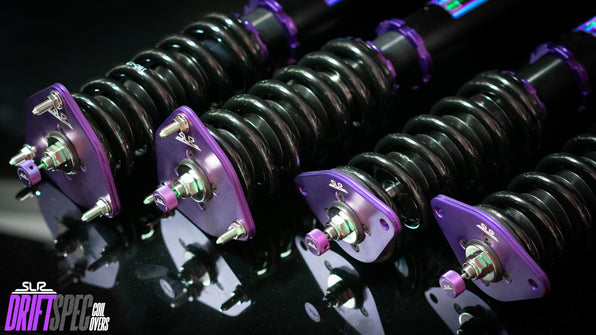
This immensely increased capability provides the pilot with dramatically enhanced control during a slide, making it much simpler to initiate a drift, sustain it through a sweeping corner, and switch fluidly from one side to the opposite. The difference in controllability is truly transformative. Paired with a correctly chosen modification is the equally critical upgrade to the car's suspension. Generic or even expensive road dampers are simply not intended for the unique and harsh demands of drifting. A purpose-built system of adjustable dampers is of utmost importance. These specialized dampers have specific damping rates and spring strength that are optimized for the rapid load shifting that is inherent of aggressive driving. When a driver starts a angle, the vehicle's inertia is shifted violently to the outside of the bend. Correct performance suspension manage this transfer in a predictable manner, permitting the vehicle to find its balance rapidly and offering the driver clear response through the steering wheel and driver's seat. They also provide exact setting of ride height, shock absorber firmness, and cross-weight, which are all fundamental elements of dialing in the vehicle's behavior to a specific venue or piloting approach. In combination, a high-quality angle modification system and a correctly selected set of performance adjustable dampers are the core mechanical base upon which all future refinement is built.
Once the fundamental components is fitted, the following critical phase in the project is the precise setting of the chassis's alignment. This is the realm of chassis dynamics adjustment, a methodology that can seem daunting to the newcomer but is, in fact, the secret to turning a set of capable components into a unified and consistent vehicle. The most debated parameter of alignment for sliding is definitely camber. Camber angle is the tilt of the rim relative to the upright line when viewed from the front of the car. If the top edge of the wheel is leaning towards the chassis, this is referred to as negative camber. For sliding, inward-leaning wheels on the front wheels is generally applied and is considered necessary. The logic is intrinsically linked to physics.
When a chassis is cornering at high sideways angles, the chassis tilts toward the outer of the bend. This body roll makes the outer front tire to reduce its best footprint with the asphalt. By introducing an inward tilt, the wheel is pre-tilted to counteract this lean. As the chassis leans into the turn, the outside front tire becomes more upright with the road surface, increasing its bite at the exact point when it is most required for control. Usually, front angles for a dedicated drift machine range from approximately -3 degrees to as extreme as -5 degrees or even more, based on the specifics of the car geometry, rubber type, and driver style. The rear wheels also employ negative camber, but the values are generally more modest and less aggressive than the front axle. Excessive inward lean at the rear can make the car excessively loose and hard to manage on power input, as it diminishes the effective grip area of the driving tires during forward throttle application. Thus, rear angles are often in the vicinity of -1 degree to -3 degrees, striking a precise balance between giving sufficient lateral bite to aid in starting and sustaining the slide while also maintaining effective traction for power-down the bend. camber angle is only one element of the more complex suspension geometry equation, which also involves toe angle, caster, and bump steer modification.
Toe angle refers to the orientation of the wheels when viewed from a bird's-eye view. Inward toe means the front edges of the tires are closer together than the trailing edges, while outward toe means the reverse. For drifting, a slight amount of front toe-out is often used to improve the initial response directional reaction, making the vehicle feel more nimble and eager to initiate a oversteer moment. Rear axle toe setting is usually set to zero or a very minute amount of positive toe to encourage predictability under acceleration. Caster is the longitudinal or backwards angle of the steering axis when looked at from the side of the chassis. Increased caster improves feedback and high-velocity confidence, and it additionally boosts inward lean effect during steering, which is extremely useful. Setting these values is a detailed dance where a adjustment to a single parameter can and will impact the other settings. The old-school method for dialing in a car's suspension geometry for sliding has historically been a time-consuming endeavor of guesswork and adjustment. A driver or crew would apply a adjustment based on intuition, run the car on track, rely on the pilot's individual perception and impressions, and then introduce a further change. This loop would iterate over and over until the chassis felt "acceptable" or the scheduled practice period ended. This approach is not just exceptionally inefficient in terms of time and resources, but it is furthermore deeply flawed.
Driver perception is a notoriously unreliable measurement tool, affected by numerous factors such as exhaustion, evolving track surfaces, temperature, and merely the mindset of the driver on that particular run. What feels "oversteery" on one lap might feel "understeery" on the subsequent pass, causing conflicting data and counterproductive tweaks. This traditional challenge in vehicle dynamics optimization is precisely where state-of-the-art engineering tools has stepped in to transform the landscape.
The rise and integration of sophisticated vehicle dynamics tools has introduced a completely new age for building and optimizing high-performance sliding vehicles. This new generation of platforms, represented by cutting-edge products like data acquisition tools, function by directly measuring the live dynamic movement of the car as it is operated on the circuit. In contrast to depending on subjective feel, these tools collect quantifiable information on key variables such as damper compression and extension, individual tire rotation, lateral and longitudinal g-forces, wheel angle, and accelerator and brake pedal input. This raw telemetry is then interpreted by powerful applications that can visualize and decode the data in a comprehensible manner. For the first time, engineers and teams can observe exactly what the car is doing at each millisecond of a drift. This capability revolutionizes the whole alignment optimization workflow. Consider the particular challenge of setting the front axle negative camber drift suspension tuning guide for a given vehicle. Rather than making a change from -3 degrees to -3.5 degrees and then running several laps to try and "sense" a difference, a telemetry system can deliver immediate and definitive feedback. The tool can show graphically how the suspension's grip is performing during the most important moments of a slide: initiation, holding the angle, and transition. It can reveal if the present camber setting is enabling the loaded tire to maintain optimal grip or if the compound is working inefficiently on its outside edge.
The software can then provide data-driven recommendations for modification. Perhaps the data indicates that the tire is still overworking its outer shoulder at -3.5 degrees of camber, suggesting that an increase to inward lean, say -4 degrees, might be beneficial. Alternatively, the information might reveal that the tread is failing to reaching temperature or that the inside shoulder is wearing too quickly, which could suggest that there is excessive angle and a slight reduction back to -3.2 degrees would be more optimal. This standard of granularity and actionable intelligence was completely unattainable in the time of pure mechanical adjustment.
The impact of using a advanced vehicle dynamics tool extends far beyond just setting camber angles. It serves as an invaluable coilover setup tips that is customized to your particular chassis. When fine-tuning the damping settings on your adjustable dampers, rather than using general tips or mimicking another car's setup, you can employ the software to analyze how the chassis is reacting in reaction to your tweaks. The software can display the damper movement path over a lap, highlighting if the shocks are handling the chassis motion effectively or if they are permitting the car to oscillate excessively after a transition. It can aid in diagnosing challenges like excessive compression or topping out, permitting you to make informed decisions to preload settings, damping settings, or stance. This methodology translates equally to the complex task of corner balancing. Beyond camber angle, the system can give data into how adjustments to toe and caster angle are influencing the vehicle's stability during specific parts of a slide. For instance, it can assist you to find the best amount of front toe-out for your individual steering configuration and competition technique by showing the speed of turn-in reaction and the stability of the chassis at lock lock. This makes the software an extremely powerful drift suspension tuning guide that is constantly informed by the actual behavior of your own chassis on the circuit. It elevates the whole endeavor from a subjective skill into a repeatable development process.
Additionally, the value of a system like modern telemetry is not restricted to expert teams with large funding. For the amateur competitor, it serves as an powerful force multiplier. It in essence provides the drift tuning app driver with the analysis of a full-time suspension specialist without the typical cost. It speeds up the tuning process by providing unambiguous directions to questions that would traditionally take countless track days of experience to understand. A builder can see how their specific car reacts to specific inputs, building a more profound knowledge drift suspension tuning guide of vehicle dynamics in the endeavor. It additionally opens up high-level chassis dynamics principles, enabling all drivers with the ambition to perfect their car to do so in a structured and effective way. This is especially valuable in a discipline like oversteer competition, where engineering expertise has in the past been a highly secretive advantage among professional crews. In the modern era, that power can be in the toolkit of every motivated driver.
In summary, the path to engineering and dialing in the ideal high-performance sliding vehicle is a comprehensive project that perfectly blends classic mechanical knowledge with 21st-century telemetry tools. It begins with the strategic pick of a legendary platform, then enhanced by the installation of non-negotiable competition hardware like maximum-angle drift angle kits and expertly specified competition coilovers. The build then progresses into the detailed stage of alignment optimization, where settings like camber, toe setting, and caster are precisely set to match the vehicle's upgraded capabilities and the operator's individual style. Ultimately, and what truly differentiates the contemporary process from the old ways, is the use of a advanced drift telemetry software. This platform eliminates the uncertainty and inefficiency of solely subjective setup by giving quantifiable, actual data on how the car is really performing. It functions as an incredible diagnostic aid, a actionable coilover setup manual, and a all-in-one vehicle dynamics tool. As a complete package, this complete methodology guarantees that all aspect of the competition vehicle—from the selection of the chassis to the last tweak on the suspension—is optimized for peak competitiveness on the competition venue. It represents the full maturation of the discipline of sliding, connecting mechanical driving skill with precise chassis dynamics to build the perfect dominant vehicles attainable.